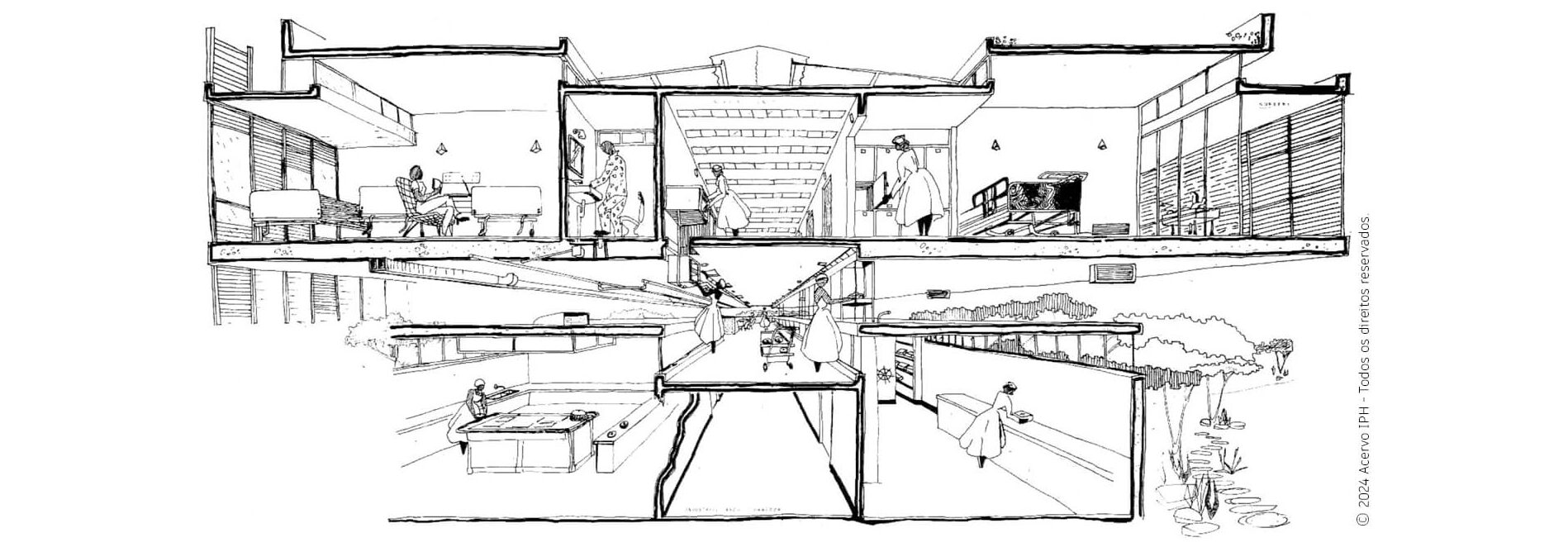
To expand the knowledge and access to information on hospitals, IPH gathered some of the main federal standards that healthcare facilities (EAS) must comply with. Standardization began in the 1940s. According to architect, professor and researcher Antonio Pedro Alves de Carvalho, the first standards were inspired by a 23-page book named Padrões Mínimos Hospitais, published by the Brazilian Special Service for Public Health – SESP, and edited by architects Roberto Nadalutti and Oscar Valdetaro, who worked at the institution at the time. The publishing of such a book indicates that architecture was already deemed important for improving healthcare institutions. This subject is further developed in an article Carvalho wrote for https://iph.org.br/revista/revista-iph-no14/ in 2017.
Currently, many institutions in Brazil are responsible for editing and publishing the standards in effect, among which:
Brazilian Health Regulatory Agency – ANVISA
Federal Council of Medicine – CFM
National Standardization Forum – ABNT
These four institutions are responsible for the ordinances, resolutions and standards that all the Brazilian territory must comply with.
In Brazil, there are also state and municipal standards, besides the federal ones, that must be referred to whenever applicable, depending on the location of the project.
Please, check the main resolutions (ANVISA), ordinances (MS and CFM) and technical standards (ABNT) regarding EAS projects and buildings:
Technical Committee Resolutions – RDCs
- RDC Nº 06/12, which rules on the good operational practices for facilities that process healthcare clothing.
- RDC Nº 06/13, which rules on the requirements of good operating practices for endoscopy services with access to the body through exclusively natural orifices.
- RDC Nº 07/10, which rules on the minimum requirements for the operation of intensive care unities.
- RDC Nº 11/14, which rules on requirements of good practices for the operation of dialysis services.
- RDC Nº 13/14, which rules on healthcare services intended to mass events of national interest.
- RDC Nº 15/12, which rules on requirements of good practices for processing health products.
- RDC Nº 20/06, which establishes the technical regulation for the operation of radiotherapy services, aiming at protecting the health of patients, healthcare professionals and everyone involved.
- RDC Nº 26/12, which changes Resolution RDC nº. 07, from February 24, 2010, which rules on the minimum requirements for the operation of intensive care units.
- RDC Nº 29/11, which rules on the sanitation safety requirements for the operation of institutions that receive people with disorders related to the use, abuse or dependency on psychoactive substances.
- RDC Nº 34/14, which rules on the good practices for the blood cycle.
- RDC Nº 36/13, which establishes actions for the safety of patients in healthcare services.
- RDC Nº 36/14, which changes Resolution RDC n° 11, from March 13, 2014, which rules on the requirements of good practices for the operation of dialysis services.
- RDC Nº 38/08, which rules on the establishment and operation of in-vivo nuclear medical services.
- RDC Nº 42/10, which rules on the obligation that every healthcare service of Brazil must provide alcoholic preparation for hand scrubbing.
- RDC Nº 44/09, which rules on the good pharmaceutical practices of sanitation control regarding operation, medication dispensing, products commercialization and services at pharmacies.
- RDC Nº 48/00, which approves the Inspection Guideline for the Hospital Infection Control Program.
- RDC Nº 50/02, which approves the technical regulation aimed at the planning, scheduling, development, assessment and approval of physical projects of healthcare facilities, which must be followed in all the Brazilian territory, both in public and private institutions.
- RDC Nº 51/11, which rules on the minimum requirements for the analysis, assessment and approval of the physical projects for healthcare facilities within the Health Regulatory National System (SNVS).
- RDC Nº 52/14, which changes Resolution RDC nº 216, from September 15, which rules on the technical regulation of good practices regarding food services.
- RDC Nº 60/09, which rules on the production, dispensing and control of medicine free samples.
- RDC Nº 61/09, which rules on the operation of histocompatibility and immunogenetics laboratories that carry out transplant-driven activities.
- RDC Nº 63/11, which rules on the requirements for healthcare service good practices.
- RDC Nº 67/07, which rules on the good practices for pharmacies to manufacture magistral and officinal preparations for human use.
- RDC Nº 149/01, which requires that public and private institutions, as well as philanthropic entities, that carry out hemotherapy activities must submit to the State and Municipal Health Regulatory Agencies the form of Hemotherapy Production Information System – HEMOPROD.
- RDC Nº 151/01, which approves the technical regulation on the complexity levels of hemotherapy services.
- RDC Nº 216/04, which rules on the technical regulation on the good practices for food services.
- RDC Nº 220/04, which approves the technical regulation on the operation of antineoplastic therapy.
- RDC Nº 222/18, which rules on the good practices for the management of healthcare waste.
- RDC Nº 275/02, which rules on the technical regulation on standardized operational procedures applied to establishments that produce and industrialize food products; it also provides the inspection list for the good practices regarding establishments that produce and industrialize food products.
- RDC Nº 307/02, which changes Resolution RDC nº 50 from February 21, 2002, which rules on the technical regulation for the planning, scheduling, developing and assessment of physical projects regarding healthcare facilities.
- RDC Nº 502/21, which rules on the operation of Long-stay Institutions for the Elderly.
Ordinances
- PRC MS/GM Nº 03 28/09/2017
- PRT MS/SAS/DRAC Nº 05 25/09/2017
- PRC MS/GM Nº 06 28/09/2017
- PRT MS/SVS Nº 48 20/01/2015
- PRT MS/SVS Nº 183 30/01/2014
- PRT MS/SVS Nº 272 08/04/1998
- PRT MS/SVS Nº 344 12/05/1998
- PRT MS/SVS Nº 453 01/06/1998
- PRI MS/MTE/GM Nº 482 16/04/1999
- PRT MS/GM Nº 551 13/04/2005
- PRT MS/GM Nº 1020 29/05/2013
- PRT MS/GM Nº 1357 02/06/2017
- PRT MS/GM Nº 1419 09/06/2017
- PRT MS/GM Nº 2048 05/11/2002
- PRT MS/GM Nº 2074 17/07/2018
- PRT MS/GM Nº 2412 11/11/2016
- PRT MS/GM Nº 2415 23/03/1998
- PRT GM/MS Nº 3523 28/08/1998
- PRT MS/GM Nº 3924 11/12/2018
Technical Standards – ABNT NBRs
- ABNT NBR 7256:2022, which rules on the minimum requirements for the design and execution of air treatment installations in healthcare facilities.
- ABNT NBR 9050:2020, which rules on the accessibility to buildings, furniture, urban spaces and equipment.
- ABNT NBR 10898:2023, which rules on the minimum requirements for emergency lighting system to be installed where required.
- ABNT NBR 12188:2016, which rules on the requirements for the installation of centralized supply systems for medical gases, gases for medical devices and vacuum for use in healthcare services.
- ABNT NBR 13433:2018, which specifies the methodology that determines the residual pH in hospital textile articles.
- ABNT NBR 13534:2008, which rules on the specific requirements for low-voltage installations in healthcare facilities.
- ABNT NBR 16651:2019, which rules on the requirements for fire protection in healthcare facilities.
Further resolutions and ordinances:
- CFM Nº1.886/2008, which rules on the minimum requirements for the operation of medical offices and surgery centers regarding short-stay procedures.